
The Influence of Dose, Time, and Frequency
Over the past six decades, the frequency, session length, and dialysis dose of HD prescriptions have empirically evolved in search of the optimal therapeutic regimen.
In the early days of HD, treatment was initially performed for 20 to 24 hours once every 5 to 7 days with notable improvement in uremic symptoms and quality of life in many patients1. However, uremic symptoms would reappear and become more severe 24-36 hours prior to the next dialysis session1. These interdialytic complications (symptoms of underdialysis), especially the accumulation of significant fluid overload and the emergence of peripheral neuropathy, prompted the initiation of a twice weekly HD regimen2–4. A further increase to thrice weekly dialysis frequency occurred to reduce the progression of neuropathy and prevent the occurrence of a gout-like syndrome5. Thrice weekly ICHD with 4-hour long sessions was eventually accepted and has remained the dominant kidney replacement therapy globally for uremic patients since the mid-1960s5,6.
A growing wealth of emerging studies, however, have challenged the traditional thrice-weekly HD dogma by showing improved outcomes with intensified treatment7–9. Alternative, personalized HD regimens – either through more frequent or longer-duration nocturnal treatment – may offer improved patient outcomes such as better volume and blood pressure control, reduced cardiovascular-related injury and hospitalizations, decreased medication dependency, and shorter post-dialysis recovery times 7–9. While the majority of HD treatments prescribed still follow the conventional HD schedule of 4-hour sessions three times weekly, frequent HD involves increasing treatment days beyond thrice weekly (4-7 days per week), extended-hours HD involves longer dialysis session duration, and intensive HD focuses on increasing cumulative weekly treatment time through a combination of increasing treatment days (frequency) and length of each dialysis session (duration)10. Dialysis treatment prescription variations can be applied in-center or at home, but the most convenient treatment location to flexibly modify treatment regimens is at home. In 2022, 86.3% of US home HD patients were prescribed 4 or more sessions per week (Figure 1), an increase from 73% in 201511.
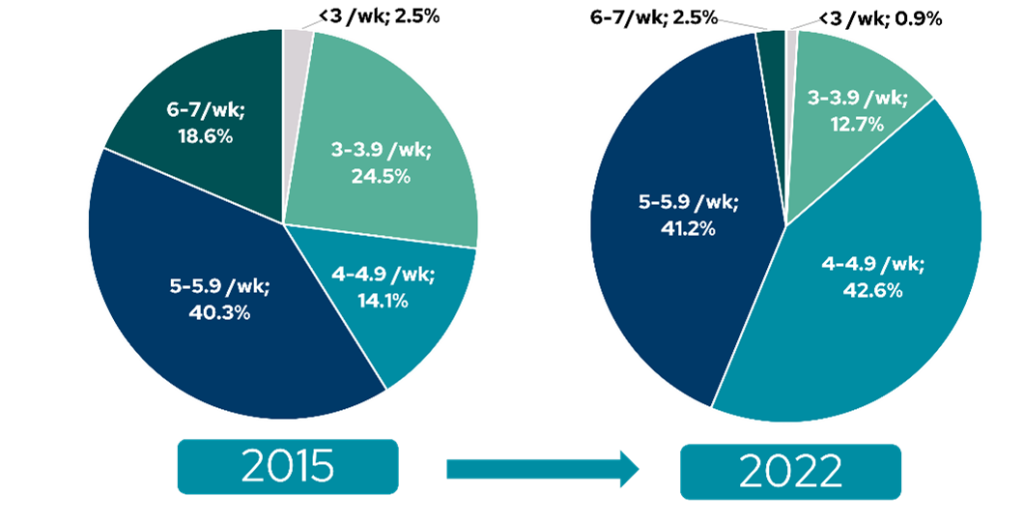
Figure 1: Prescribed number of treatments per week in adult patients performing home HD in the US. In 2022, 12.7% patients were prescribed 3-3.9 sessions per week, 42.6% of patients were prescribed 4 to 4.9 sessions per week, and 41.2% of patients were prescribed 5-5.9 sessions per week (Adapted from USRDS 2024 ADR11 Chapter 2: Home Dialysis. Figure 2.11a).
This overview explores the current state of research in various HD treatment schedules and the impact of dose, time, and frequency on clinical outcomes of HD.
References:
- SCRIBNER BH, BURI R, CANER JE, HEGSTROM R, BURNELL JM. The treatment of chronic uremia by means of intermittent hemodialysis: a preliminary report. Trans Am Soc Artif Intern Organs. 1960;6:114-122. Available from: http://www.ncbi.nlm.nih.gov/pubmed/13749429.
- Curtis FK, Cole JJ, Fellows BJ, Tyler LL, Scribner BH. Hemodialysis in the home. Trans Am Soc Artif Intern Organs. 1965;11:7-10.
- De Palma JR. Daily hemodialysis: A very old concept. Semin Dial. 1999;12(6):406-409.
- Hegstrom RM, Murray JS, Pendras JP, Burnell JM, Scribner BH. Two year’s experience with periodic hemodialysis in the treatment of chronic uremia. Trans Am Soc Artif Intern Organs. 1962;8:266-280.
- Scribner BH, Cole JJ, Ahmad S, Blagg CR. Why thrice weekly dialysis? Hemodialysis International. 2004;8(2):188-192.
- Eschbach Jr J, Wilson Jr W, Peoples R, Wakefield A, Babb A, Scribner B. Unattended overnight home hemodialysis. Trans Am Soc Artif Intern Organs. 1966;12:346-356.
- Ok E, Demirci C, Asci G, et al. Patient Survival With Extended Home Hemodialysis Compared to In-Center Conventional Hemodialysis. Kidney Int Rep. 2023;8(12):2603-2615. Available from: https://pubmed.ncbi.nlm.nih.gov/38106580/.
- Chertow GMG, Levin NNW, Beck GGJ, et al. In-center hemodialysis six times per week versus three times per week. N Engl J Med. 2010;363(24):2287-2300. Available from: http://www.ncbi.nlm.nih.gov/pubmed/21091062.
- Jaber BL, Lee Y, Collins AJ, et al. Effect of daily hemodialysis on depressive symptoms and postdialysis recovery time: interim report from the FREEDOM (Following Rehabilitation, Economics and Everyday-Dialysis Outcome Measurements) Study. Am J Kidney Dis. 2010;56(3):531-539. Available from: http://www.ncbi.nlm.nih.gov/pubmed/20673601.
- Perl J, Chan CT. Home hemodialysis, daily hemodialysis, and nocturnal hemodialysis: Core Curriculum 2009. American journal of kidney diseases. 2009;54(6):1171-1184. Available from: http://www.ncbi.nlm.nih.gov/pubmed/19748715.
- United States Renal Data System. 2024 USRDS Annual Data Report: Epidemiology of Kidney Disease in the United States. National Institutes of Health, National Institute of Diabetes and Digestive and Kidney Diseases, Bethesda, MD, 2024.
GMO-001410 Rev B 11/2024