

A Patient’s Journey Through Transitional Care
New Course!
This course will review the important transition points in the care of dialysis patients and how Transitional Care Units, or TCUs, can facilitate these transitions. Discussions will include physician, patient, and care advocate perspectives on the use and outcomes of TCUs.
Person-Centered Approach to Home Dialysis Growth
This course will discuss current trends in home dialysis utilization and its outcomes. Drs. Saxena and Voinescu will identify strategies to increase the growth of home dialysis by focusing on what matters most to patients and how to achieve these goals. Practical application of the key principles will be discussed with patient cases the end of the course.
The Kidneys in Health and Disease
This course will review renal anatomy and nephron structure, principles of renal physiology, Acute Kidney Injury (AKI) prevalence and classification, Chronic Kidney Disease (CKD) prevalence and classification. #Spanish
If you have purchased CME credit(s) for this course, please click HERE to view the Learner Notification.

Peritoneal Dialysis (PD) Dropouts and Transitioning to Hemodialysis
This course will provide an overview of current trends in the utilization of home dialysis modalities, with a special focus on understanding the factors contributing to peritoneal dialysis (PD) dropouts. Participants will examine common clinical, psychosocial, and system-level causes of PD discontinuation and gain insights into best practices for managing transitions from PD to hemodialysis (HD). The course will also discuss the integrated care model that supports seamless transitions from PD to home hemodialysis (HHD), highlighting strategies to optimize patient outcomes, preserve autonomy, and sustain long-term home dialysis success.

Peritoneal Dialysis Essentials (Modules 1-3)
This course introduces the principles of peritoneal dialysis (PD). It reviews the essential components of PD such as the anatomy of the peritoneum, the concepts behind solute and fluid transport, patient selection criteria and the components of a successful PD program.
If you have purchased CME credit(s) for this course, please click HERE to view the Learner Notification.
The PD Prescription
In this course, we will review peritoneal dialysis modalities, discuss the steps necessary for determining the initial PD prescription, as well as ways to evaluate and optimize the prescription according to current guidelines and recommendations. We will utilize the online PD calculator to walk through patient cases and illustrate important clinical considerations.
If you have purchased CME credit(s) for this course, please click HERE to view the Learner Notification.
Peritoneal Dialysis (PD) Access
This course describes the underlying concepts in peritoneal dialysis (PD) access and how they can be applied to the improvement of clinical outcomes. It teaches how to identify the appropriateness of catheter type based on individual patient characteristics and incorporate appropriate patient preparation procedures into patient care. This peritoneal dialysis (PD) access course also covers how to recognize common signs and symptoms of complications associated with PD access
Fluids, Electrolytes, Acids and Bases
This course provides a comprehensive overview on major components of body fluid, mechanisms of homeostasis and their impact on fluid movement. It will review acid/base chemistry and roles of electrolytes in normal body functions. It will also cover how these components are regulated by the kidneys, the possible causes, symptoms and treatment strategies of imbalances in patients with kidney disease.
Composition of PD Solutions and Their Clinical Application
This course provides a comprehensive overview of the dialysate solutions used in peritoneal dialysis; the composition and the role of each constituent. It will review the biocompatability of the conventional dextrose based solutions with special regards to the pH, Glucose Degradation Products (GDPS) and Advanced Glycosylation Endproducts (AGEs), and their effect on the peritoneal membrane. The course will also discuss the alternative PD solutions and their impact on peritoneal membrane, technique survival and patient outcomes.
If you have purchased CME credit(s) for this course, please click HERE to view the Learner Notification.
Understanding and Applying the PET
This course will provide an overview on the purpose of peritoneal testing, how to perform a Peritoneal Equilibration Test (PET) and identifying common mistakes during a PET. It will review the parameters in a PET lab report and discuss patient cases to demonstrate how PET results can be used to customize PD prescriptions. #Spanish
If you have purchased CME credit(s) for this course, please click HERE to view the Learner Notification.
Clinical and Surgical Management of Non-Infectious Complications in PD
This course will discuss common causes of non-infectious complications of peritoneal dialysis (PD) and review patient case examples on the prevention, recognition, and management of non-infectious PD complications. A comprehensive roundtable discussion will cover many frequently asked questions from the clinical and surgical aspects.
If you have purchased CME credit(s) for this course, please click HERE to view the Learner Notification.
Peritoneal Dialysis Exit-Site Classification
This course will discuss peritoneal dialysis (PD) catheter exit-site infection (ESI), risk factors and accepted classification schemes. We will also review characteristics of different exit-site categories. We will also discuss how to perform ESI rate calculations and review elements and best practice guidelines for exit-site care.
Peritonitis in Peritoneal Dialysis
This course provides up-to-date information on the classification, diagnosis and treatment of peritonitis in peritoneal dialysis (PD) patients according to the updated 2016 ISPD guideline recommendations. It also covers patient and treatment-related factors that can impact peritonitis and discusses prevention strategies.
If you have purchased CME credit(s) for this course, please click HERE to view the Learner Notification.
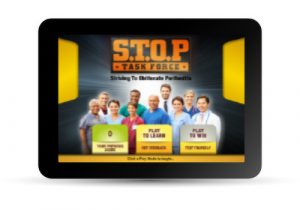
Welcome to the S.T.O.P Peritonitis Task Force Game!
This game provides a simulated clinic environment for you to manage your patients. You need to review medical records and lab data in order to select the appropriate treatments for your patients. You may learn materials by clicking on the “Play To Learn” mode when you enter the game. You may test yourself by clicking on the “Play To Win” mode and earn points moving up from Level 1 to Level 2.
You will gain a better understanding on the ISPD peritonitis recommendations 2022 update on prevention and treatment after the completion of this activity.
Challenge yourself to obliterate peritonitis now!
Transitions in Care for Dialysis Patients
Dr. Leslie Wong provides a dynamic and comprehensive presentation on transitioning patients to home dialysis. In this recorded session, Dr. Wong will review important transition points in the care of dialysis patients, discuss practical aspects of Transitional Care Units (TCU), analyze patient outcomes from TCUs, and outline methods to screen and identify appropriate patients for home dialysis. He will also briefly discuss incremental start dialysis, urgent start dialysis, and transitioning from PD to HHD.
Transitioning from Peritoneal Dialysis to Home Hemodialysis
This course will provide an overview on Peritoneal Dialysis (PD) to Home Hemodialysis (HHD) transition pathways, potential reasons for PD technique failure, patient considerations on choosing HHD. It will highlight the importance of early modality education and the outcomes with a PD to HHD approach.
*This is currently available as non-CE course only.
A Practical Approach to Sodium Management in Dialysis Patients
This course will review sodium balance and toxicity in dialysis patients, discuss the role of sodium (NA) according to the new understanding of physiology, explain sodium-water imbalances in dialysis patients, describe dietary approach and sodium management in Hemodialysis (HD) and peritoneal dialysis (PD) patients. #Spanish
If you have purchased CME credit(s) for this course, please click HERE to view the Learner Notification.
Understanding Hyperphosphatemia and Mineral Bone Disorder
This course discusses the pathophysiology of Mineral Bone Disorder in chronic kidney disease (CKD) and reviews the roles of the major players in mineral bone homeostasis. The course also provides an introduction to the management and treatment approaches for this disorder. #Spanish
Learn about the 2017 Updates of the KDOQI Mineral and Bone Disorder Guidelines and stay up-to-date with topics related to MBD diagnosis, recommended phosphorus intake, goal phosphorus levels, goal PTH levels, and MBD in transplant patients. The key differences between the 2017 and 2009 guideline recommendations are highlighted in the short presentation. Full guideline document can be accessed at the end of the presentation or by clicking on the references icon. Click Here to start presentation.
If you have purchased CME credit(s) for this course, please click HERE to view the Learner Notification.
Fluid Management in Kidney Disease
This course will describe fluid compartments of the body and the role of the kidneys in fluid management, the consequences of fluid overload in kidney disease, guideline recommendations on fluid management approaches and the principles and applications of tools for measuring and evaluating fluid overload in patients with kidney disease. #Spanish
If you have purchased CME credit(s) for this course, please click HERE to view the Learner Notification.
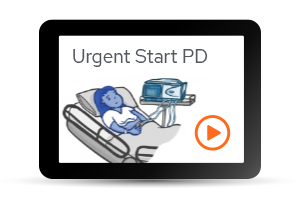
Urgent Start Peritoneal Dialysis Animated Video
This animated video will provide an overview on urgent start PD. It will highlight some key logistic considerations such as how to identify the appropriate candidates, provide patient education, create PD access, initiate the right prescription and provide nursing staff training. This video will also discuss potential risks and benefits of urgent start PD.
Urgent Start Peritoneal Dialysis
In this course, we will describe the history of dialysis initiation and define urgent start Peritoneal Dialysis (PD), review the outcomes, potential benefits, and risks associated with urgent start PD, discuss the logistic and prescription considerations of urgent start PD, and examine the use of PD for acute kidney injury. #Spanish
If you have purchased CME credit(s) for this course, please click HERE to view the Learner Notification.
Prise en charge clinique et chirurgicale des complications non infectieuses de la DP
Ce cours discutera des causes courantes des complications non infectieuses de la dialyse péritonéale (DP) et passera en revue des exemples de cas de patients sur la prévention, la reconnaissance et la gestion des complications non infectieuses de la DP. Une table ronde complète couvrira de nombreuses questions fréquemment posées sur les aspects cliniques et chirurgicaux. #French
Comprendre et appliquer le PET
Ce cours donne un aperçu de l'objectif des tests péritonéaux, comment effectuer un test d'équilibration péritonéale (PET) et identifier les erreurs courantes lors d'une PET. Il examinera les paramètres dans un rapport de laboratoire PET et discutera des cas de patients pour démontrer comment les résultats du PET peuvent être utilisés pour personnaliser les prescriptions de DP. #French
Travailler avec la prescription de dialyse péritonéale
Dans ce cours, nous aborderons les modalités actuelles de dialyse péritonéale, les étapes nécessaires pour déterminer la prescription initiale, ainsi que les moyens d’améliorer la prescription selon les directives et recommandations en vigueur. #French
Les bases de la dialyse péritonéale
Ce cours introduit les principes de la dialyse péritonéale (PD). Il donne un aperçu général des composantes essentielles de la DP, telles que l'anatomie du péritoine, les concepts du transport de soluté et de fluide, les critères de sélection des patients et les composantes d'un programme de DP fructueux. #French
Solutions de dialyse péritonéale (DP)
Ce cours donne un aperçu général des électrolytes, agents osmotiques et bases tampons actuellement utilisés dans les solutions de dialyse péritonéale (SDP). Le cours aborde également la biocompatibilité des SDP avec une attention particulière aux produits de dégradation du glucose (PDG) et aux produits terminaux de glycation avancée PTGA. #French